
Call Us:
+91 98291 85611
Office Address
123/A, Kasturab Marg
Vijay Path, Jaipur – 302020
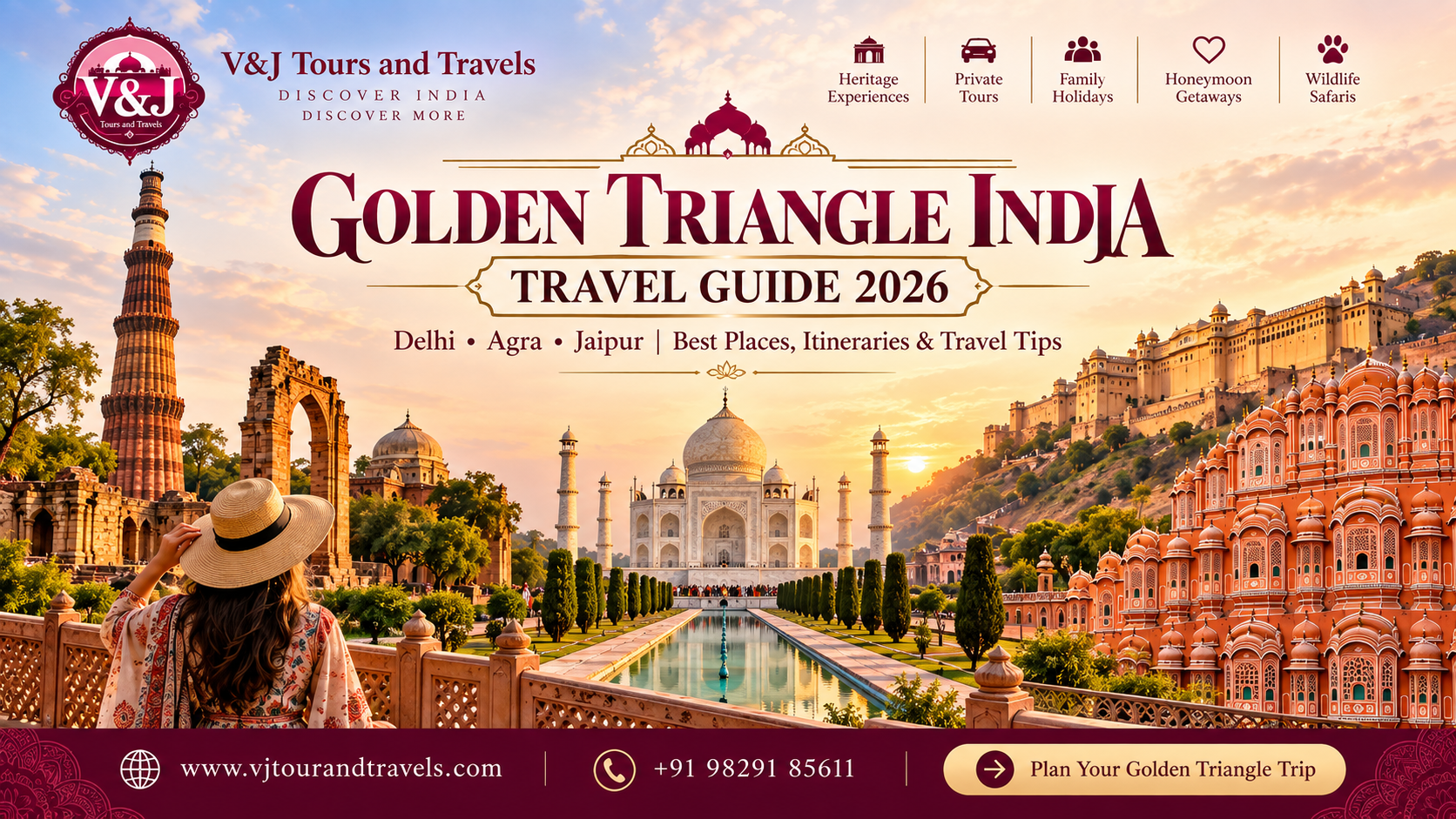
If you are visiting India for the first time, deciding where to go can feel overwhelming. India is enormous, and even a single region can offer weeks of history, culture, food and experiences.
That is exactly why the Golden Triangle of India is such a popular starting point.
The classic route connects Delhi, Agra and Jaipur—three cities that together introduce travellers to India’s historic capital, Mughal heritage, Rajput architecture, colourful markets, regional food and living culture.
For many travellers, the route is also practical. Instead of trying to cover too much of India at once, you can experience three very different destinations within one well-connected journey.
But planning the Golden Triangle properly matters. How many days should you spend in each city? Should you travel by train or private car? Is five days enough? What does a Golden Triangle trip cost? Can you add Ranthambore, Jodhpur or Jaisalmer?
This guide explains everything you need to know before planning your journey.
Planning your own Delhi–Agra–Jaipur holiday? V&J Tours & Travels can help create a private itinerary around your travel dates, group size, preferred hotels and travel style.
The Golden Triangle of India is a popular tourist circuit connecting:
The three destinations form a roughly triangular route across northern India.
Each city contributes something different to the journey.
Delhi introduces you to India’s historic and modern capital, with Mughal monuments, colonial-era landmarks, busy markets and diverse food.
Agra is famous worldwide for the Taj Mahal, while Agra Fort and other Mughal-era sites reveal the city’s deeper history.
Jaipur, the Pink City, brings the journey into Rajasthan with spectacular forts, palaces, traditional markets and Rajput heritage.
That combination is what makes the Golden Triangle so effective for first-time visitors: you are not seeing three versions of the same destination. You are experiencing three distinctly different sides of India.
The name comes from the geographical relationship between the three cities.
On a map, Delhi, Agra and Jaipur create a triangle-like travel route. The word “Golden” reflects the enormous historical, cultural and architectural value concentrated along this circuit.
The route brings together:
For a traveller who has never visited India, this makes the Golden Triangle a convenient introduction to the country.
| Destination | Best Known For | Suggested Stay | Ideal For |
|---|---|---|---|
| Delhi | History, monuments, food and culture | 1–2 nights | First-time visitors, food lovers, history |
| Agra | Taj Mahal and Mughal heritage | 1 night | Couples, history lovers, photographers |
| Jaipur | Forts, palaces and Rajasthan culture | 2–3 nights | Families, couples, culture lovers |
A comfortable trip generally works better when you avoid trying to see everything in a single day.
If your schedule allows, give Jaipur enough time to experience the city beyond its most famous monuments.
Delhi is often the first stop for international travellers because it is one of India’s major gateways.
But Delhi is more than simply a place to arrive before travelling to Agra.
It is a destination in its own right.
The city combines centuries of history with modern neighbourhoods, restaurants, markets and contemporary culture.
Depending on your interests and available time, your Delhi itinerary could include:
Old Delhi provides a very different atmosphere from the newer parts of the city.
Its narrow lanes, historic buildings, markets and food culture offer a glimpse into an older side of Delhi.
Travellers interested in food should consider making time for a local culinary experience.
Qutub Minar is one of Delhi’s best-known historic monuments and an important stop for travellers interested in architecture and medieval Indian history.
Humayun’s Tomb is particularly interesting for visitors who want to understand the architectural development that eventually influenced later Mughal monuments.
For a classic Golden Triangle trip, one to two nights can work well.
If Delhi is your arrival point after a long international flight, spending two nights can provide a much more relaxed beginning.
The Taj Mahal is a UNESCO World Heritage Site, one of the world’s most recognisable monuments and the central reason many travellers include Agra in their India itinerary.
From Delhi, the journey continues towards Agra.
For most international visitors, Agra is synonymous with one monument:
The Taj Mahal is one of the world’s most recognisable monuments and the central reason many travellers include Agra in their India itinerary.
But Agra should not be treated as simply a “Taj Mahal stop.”
The city has a much broader Mughal heritage.
Depending on your itinerary, consider:
Many travellers prefer visiting the Taj Mahal early in the day.
The exact experience will depend on your travel dates, weather, crowd conditions and opening arrangements, so always check current official visitor information before travelling.
For photographers and couples, timing can be particularly important.
Agra Fort provides essential historical context to the Taj Mahal.
While the Taj Mahal represents one of the most famous examples of Mughal architecture, Agra Fort helps visitors understand the political and royal history behind the Mughal capital.
For the classic Golden Triangle, one night is often sufficient.
Travellers with a particularly strong interest in Mughal history may choose to stay longer.
After Agra, the route continues towards Jaipur.
This is where your Golden Triangle journey starts to feel distinctly Rajasthani.
Jaipur combines:
For many travellers, Jaipur becomes one of the highlights of the entire journey. Travellers planning a broader Rajasthan journey can explore V&J’s Rajasthan tours.
A well-planned Jaipur itinerary can include:
Amber Fort is one of Jaipur’s most important attractions.
Its hilltop setting, courtyards, architecture and historical significance make it a major highlight.
City Palace provides insight into Jaipur’s royal history and remains an important cultural attraction.
The Palace of Winds is one of Jaipur’s most recognisable landmarks and a favourite location for photography.
Do not make the mistake of treating Jaipur only as a collection of monuments.
The city’s markets are part of the experience.
Depending on your interests, you may find:
Ideally, allow two to three nights.
A rushed one-day Jaipur visit can cover the major sights, but it leaves little room for markets, food, photography and relaxed exploration.
| Feature | Delhi | Agra | Jaipur |
|---|---|---|---|
| Main Character | Capital city | Mughal heritage city | Rajasthani royal city |
| Architecture | Mughal, colonial and modern | Mughal | Rajput and royal |
| Famous Landmark | Qutub Minar / Red Fort | Taj Mahal | Amber Fort / Hawa Mahal |
| Food | Extremely diverse | Mughlai influences | Rajasthani cuisine |
| Shopping | Markets and modern retail | Handicrafts | Textiles, jewellery and crafts |
| Couples | Excellent | Excellent | Excellent |
| Families | Excellent | Excellent | Excellent |
| Recommended Stay | 1–2 nights | 1 night | 2–3 nights |
The key point is that these destinations complement each other.
Delhi gives you the capital and a huge range of history.
Agra gives you the Mughal heart of the journey.
Jaipur introduces you to Rajasthan.
There is no single perfect duration.
Your ideal itinerary depends on how quickly you like to travel.
A four-day itinerary is possible for travellers with very limited time.
However, it will be relatively fast-paced.
A typical structure could be:
Day 1: Delhi
Day 2: Delhi → Agra
Day 3: Agra → Jaipur
Day 4: Jaipur → departure
This works better for travellers who want a quick introduction rather than a relaxed holiday.
Five days gives you more breathing room.
A possible structure:
Day 1: Delhi
Day 2: Delhi → Agra
Day 3: Agra → Jaipur
Day 4: Jaipur
Day 5: Jaipur → departure
This is a good option for travellers who have limited annual leave.
Six days is a particularly useful balance between sightseeing and travel time.
You can allocate more time to Delhi and Jaipur while still experiencing Agra properly.
Travellers interested in a ready-made itinerary can explore V&J Tours & Travels’ 6-day Golden Triangle India tour as a starting point for planning their journey.
Seven days allows a more relaxed approach.
You can spend:
with additional flexibility for sightseeing, food, markets and local experiences.
If you have more time, there is little reason to stop at Jaipur.
You can extend your journey towards:
For travellers who want to explore Rajasthan beyond Jaipur, a Jaipur Jodhpur Jaisalmer tour can be a practical extension.
The classic direction is:
Delhi → Agra → Jaipur
This route works well because it creates a logical progression from India’s capital to Mughal heritage and then into Rajasthan.
However, your actual route can depend on:
If you are flying into Delhi and out of Delhi, your itinerary may need to be structured as a round trip.
If you are flying into Delhi and out of Jaipur, the classic route can be particularly convenient.
There are several ways to travel around the Golden Triangle.
For families, couples and small groups, private transportation can provide significant convenience.
Benefits include:
This is especially useful when you are travelling with children or older family members.
A private journey also makes it easier to combine sightseeing with hotel transfers rather than managing multiple transport bookings yourself.
Train travel can be a good option for travellers who enjoy India’s railway experience or want to prioritise rail travel.
However, you need to consider:
Group tours can work for travellers who prefer a structured schedule and shared transportation.
The trade-off is generally less flexibility.
If you want to choose when you leave your hotel, how long you spend at a monument or where you stop for lunch, private travel may be more suitable.
One of the most common questions travellers ask is:
“How much does a Golden Triangle trip to India cost?”
There is no single price because the total cost depends heavily on how you travel.
Key factors include:
A private tour for two people has a different per-person cost from a private tour for a family or larger group.
Your accommodation can range from practical mid-range hotels to luxury heritage properties.
Prices can vary depending on season and availability.
The vehicle required for two travellers will differ from what is appropriate for a family or larger group.
Some travellers prefer guides in each destination, while others prefer independent sightseeing.
A four-day itinerary naturally costs less than a ten-day journey.
Adding Ranthambore, Jodhpur, Jaisalmer or Udaipur increases both time and overall cost.
Instead of choosing a package only by price, decide what type of experience you want.
Focus on practical accommodation and essential sightseeing.
A balance of comfortable hotels, private transportation and sightseeing.
Better hotels, more personalised experiences and additional flexibility.
High-end accommodation, premium transport, private experiences and a more relaxed itinerary.
The most useful approach is to request a quote based on your actual trip.
Tell V&J:
and ask for a custom Golden Triangle itinerary and quotation.
The best travel period depends on your tolerance for heat, your preferred experiences and your travel dates.
This period can offer comfortable conditions for sightseeing and is popular with travellers.
Winter is an important travel period for the Golden Triangle.
Mornings and evenings can be cool, particularly in Delhi and Rajasthan, so pack accordingly.
Temperatures begin to rise, but travel can still be enjoyable with sensible scheduling.
This can be extremely hot, particularly during the daytime.
Travellers visiting during this period should plan sightseeing around the weather.
The monsoon period can bring a different experience, with changing weather conditions and occasional rain.
For many first-time travellers who want comfortable sightseeing conditions, the cooler months are often the most attractive.
Always check current weather conditions before finalising your plans.
The Golden Triangle can work extremely well for family travel when the itinerary is not overloaded.
A family-friendly plan should consider:
This is one reason private tours can be useful for families.
You can adjust the pace rather than following a fixed group schedule.
If your priority is a broader Rajasthan family holiday, V&J also offers dedicated Rajasthan family itineraries that can be considered alongside the classic Golden Triangle.
Delhi, Agra and Jaipur can also work beautifully as a couple’s itinerary.
The Taj Mahal naturally makes Agra a memorable stop, while Jaipur provides opportunities to experience heritage architecture, markets, restaurants and Rajasthan’s royal atmosphere.
Couples can also extend the journey into:
For couples who want a longer Rajasthan experience, consider combining the Golden Triangle with a dedicated Rajasthan honeymoon itinerary rather than treating Delhi–Agra–Jaipur as the entire holiday.
If this is your first trip to India, the Golden Triangle can be an excellent introduction.
But there are a few things to understand before you go.
Delhi and Agra can be intense.
Traffic, markets, crowds and constant activity are part of the experience.
Do not expect every destination to feel like a quiet European holiday city.
You do not need to fill every hour.
A good itinerary leaves space for:
A good local guide can provide historical context that you would otherwise miss.
Instead of simply seeing a monument, you understand why it matters.
Travel conditions can change.
Building some flexibility into your itinerary can make the trip much more enjoyable.
A practical packing list includes:
Comfortable footwear is particularly important because sightseeing often involves considerable walking.
Food is one of the best reasons to experience the Golden Triangle.
Delhi offers an enormous range of Indian and international cuisine.
Explore both traditional food areas and modern restaurants.
Agra has strong Mughlai influences and is a good place to explore North Indian flavours.
Jaipur introduces travellers to Rajasthani cuisine.
Depending on your preferences, look for dishes and experiences involving:
If you have dietary restrictions, communicate them when planning your itinerary.
Each destination offers a different shopping experience.
Ideal for travellers looking for a broad mixture of traditional and modern shopping.
Known for handicrafts and products associated with its heritage traditions.
Particularly attractive for:
When shopping, compare prices and understand what you are buying before making a purchase.
If you have additional time, Ranthambore is one of the most popular extensions to the classic Golden Triangle.
The combination becomes:
Delhi → Agra → Jaipur → Ranthambore
This adds a completely different experience to the trip.
Instead of only focusing on monuments and cities, you introduce:
For travellers who want this combination, a dedicated Golden Triangle with Ranthambore itinerary can be more practical than trying to add the destination independently.
Jodhpur adds another important layer of Rajasthan.
The city is known for its:
A longer itinerary can therefore move from:
Delhi → Agra → Jaipur → Jodhpur
This works particularly well for travellers who want more Rajasthan after completing the Golden Triangle.
Want to experience the Thar Desert?
Continue beyond Jaipur towards Jaisalmer.
A longer journey can include:
Delhi → Agra → Jaipur → Jodhpur → Jaisalmer
Jaisalmer adds:
For travellers interested in the desert, V&J’s Jaisalmer Desert Experience can be a useful extension to consider.
Udaipur offers yet another side of Rajasthan.
Its lakes, palaces and romantic atmosphere make it particularly popular with couples.
An extended itinerary could combine:
Delhi → Agra → Jaipur → Udaipur
Travellers looking for a shorter Rajasthan combination can also consider a Jaipur Udaipur tour.
or continue through additional Rajasthan destinations.
Ask yourself five questions:
Less than five days requires a faster itinerary.
Seven or more days allows a more relaxed journey.
A couple, family and group may need very different schedules.
History?
Food?
Luxury?
Wildlife?
Photography?
Shopping?
Culture?
Your accommodation budget can significantly affect your overall trip.
If yes, consider adding Ranthambore, Jodhpur, Jaisalmer, Udaipur or Pushkar.
A private tour is not automatically better for everyone.
But for travellers who value flexibility, it can make a major difference.
With a private itinerary, you can potentially customise:
It can also make the trip easier for families and small groups.
Instead of fitting your holiday around somebody else’s schedule, the itinerary is designed around your journey.
For a Golden Triangle journey that continues into Rajasthan, working with a Jaipur-based travel company can provide a useful local perspective.
V&J Tours & Travels focuses on private and customizable India and Rajasthan journeys, including Golden Triangle itineraries and Rajasthan extensions.
The goal should not simply be to move travellers from Delhi to Agra to Jaipur.
A well-designed journey should consider:
That is where a custom itinerary can be more useful than selecting a generic package.
The process can be simple.
Tell V&J when you plan to arrive in India and how long you have.
Mention:
Tell the team whether you prefer:
and what experiences interest you.
Your Delhi, Agra and Jaipur route can then be structured around your priorities.
If you have additional time, consider:
Once your requirements are clear, you can request a personalised quotation.
The Golden Triangle is one of the easiest ways for a first-time visitor to experience several very different sides of India.
You can start with the historic energy of Delhi, experience the extraordinary Mughal heritage of Agra, and then continue into the colourful royal culture of Jaipur.
And if you have more time, the journey does not need to end there.
Ranthambore, Jodhpur, Jaisalmer, Udaipur and other Rajasthan destinations can turn a classic Golden Triangle trip into a much broader India holiday.
Tell V&J Tours & Travels:
and ask for a custom Delhi–Agra–Jaipur itinerary.
Plan Your Golden Triangle Trip
Request a Custom Quote
Contact V&J Tours & Travels
The Golden Triangle is a popular northern India travel circuit connecting Delhi, Agra and Jaipur.
A fast trip can be completed in around four to five days, while six to seven days generally allows a more relaxed experience.
The classic Golden Triangle consists of Delhi, Agra and Jaipur.
Yes. The route combines India’s capital, Mughal heritage and Rajasthan’s royal culture, making it a strong introduction to northern India.
The cooler months are generally popular for sightseeing, while the warmer and monsoon periods offer different travel conditions. Check current weather conditions before travelling.
There is no universal price. Costs depend on accommodation, dates, number of travellers, transportation, guides, trip duration and additional destinations.
For travellers who value flexible schedules, private transportation and personalised itineraries, a private tour can provide significant convenience.
Yes. A private itinerary can potentially be adjusted according to your travel dates, interests, hotel preference, pace and budget.
Yes. Families can benefit from private transportation, flexible sightseeing schedules and accommodation selected around their needs.
Absolutely. Agra’s Taj Mahal and Jaipur’s heritage atmosphere make the route particularly attractive for couples.
Yes. Ranthambore is a popular extension for travellers who want to combine India’s heritage cities with a wildlife experience.
Yes. With additional time, Jaisalmer can be added for travellers interested in the Thar Desert and desert experiences.
One day can cover the major highlights, but two or three nights generally allow a more comfortable experience.
You can contact V&J Tours & Travels with your dates, traveller details, preferred accommodation and itinerary requirements to request a customised trip proposal.
The biggest mistake with a Golden Triangle trip is trying to see too much in too little time.
Delhi, Agra and Jaipur may look close together on a map, but each destination deserves time to experience beyond its headline attraction.
Plan the route around your travel style, not just the number of monuments you can tick off.
And if you want to continue beyond Jaipur, Rajasthan gives you an enormous number of ways to extend the journey.
Your Golden Triangle does not have to be a fixed package. It can be the starting point for a personalised India journey.
Comments are closed